


Reporting Group
MASTER
Discovering Data Source
MASTER
Discovery Date
2019-12-05 19:29:33.000
TNS AT
Y
Public
Y
Discovery Mag
18.2
Filter
Clear-
Reporter/s
T.Pogrosheva, V. Lipunov, E. Gorbovskoy, V.Kornilov, N.Tyurina, P.Balanutsa, A.Kuznetsov, F.Balakin, V.Vladimirov, D. Vlasenko, I.Gorbunov, D.Zimnukhov, V.Senik, T.Pogrosheva, D.Kuvshinov (Lomonosov Moscow State University, SAI, Physics Department), R. Podesta, C.Lopez, F. Podesta, C.Francile (Observatorio Astronomico Felix Aguilar OAFA), H.Levato (Instituto de Ciencias Astronomicas, de la Tierra y del Espacio ICATE), R. Rebolo, M. Serra (The Instituto de Astrofisica de Canarias), D. Buckley (South African Astronomical Observatory), O.A. Gres, N.M. Budnev, O.Ershova (Irkutsk State University, API), A. Tlatov, D. Dormidontov (Kislovodsk Solar Station of the Pulkovo Observatory), V. Yurkov, A. Gabovich, Yu. Sergienko (Blagoveschensk Educational State University)
Light curves
▌Other_Other_Clear
Pointer position (MJD, Mag, Abs.Mag): (0.00, 0.00, 0.00)
Spectra
No Data
Light Curves
AT Reports
| ID | Time received (UT) | Sender | Reporter/s | Reporting group | Disc. Data Source | RA | DEC | Discovery date (UT) | Discovery Mag. | Filter | Related files | AT Type | Host name | Internal name | Assoc. Groups | End prop. period | Remarks | ADS Bibcode | Unreal | Auto classification |
|---|---|---|---|---|---|---|---|---|---|---|---|---|---|---|---|---|---|---|---|---|
| 54067 | 2019-12-07 15:29:41 | MASTER | T.Pogrosheva, V. Lipunov, E. Gorbovskoy et al. | MASTER | MASTER | 02:51:16.510 | -03:53:25.40 | 2019-12-05 19:29:33.000 | 18.2 | Clear- | PSN | MASTER OT J025116.51-035325.4 | MASTER | MASTER inspect | 2019TNSTR2549....1P | N |
Classification Reports
No Data
Comments
Low-mass star or brown dwarf
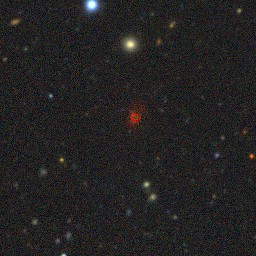
As noticed by Jörg Schümann: The position is consistent with a high proper motion object, the L3-dwarf 2MASS J02511490-0352459. The R-band shows 18.85 mag and 16.51 in the I-band in SIMBAD from Liebert & Gizis 2006. The above transient discovery shows 18.2 with CLEAR filter.
The discovery report describes the last non-detection at 2015-09-20 and with a total proper motion of about 2 arcsec/year (Jameson et al. 2008), it would travel about 8 arcsec in these 4 years. Maybe enough to confuse any automatic detection of a transient.