


*** This object was marked as unreal - check the AT report/s for details ***
Reporting Group
None
Discovering Data Source
None
Discovery Date
2023-11-30 02:27:00.000
TNS AT
Y
Public
Y
Discovery Mag
18
Filter
I-Cousins
Reporter/s
Filipp Romanov
Light curves
▌Other_Other_I
Pointer position (MJD, Mag, Abs.Mag): (0.00, 0.00, 0.00)
Spectra
No Data
Light Curves
AT Reports
| ID | Time received (UT) | Sender | Reporter/s | Reporting group | Disc. Data Source | RA | DEC | Discovery date (UT) | Discovery Mag. | Filter | Related files | AT Type | Host name | Internal name | Assoc. Groups | End prop. period | Remarks | ADS Bibcode | Unreal | Auto classification |
|---|---|---|---|---|---|---|---|---|---|---|---|---|---|---|---|---|---|---|---|---|
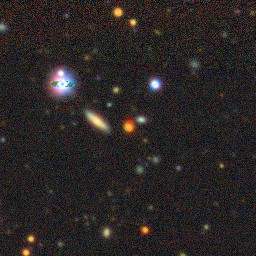
| 194738 | 2023-11-30 04:52:46 | Filipp Romanov | Filipp Romanov | 00:49:17.780 | -81:29:45.83 | 2023-11-30 02:27:00.000 | 18 | I-Cousins | Other | F. D. Romanov | [I have determined that AT 2023yph is a star #4631003097698452224 from the Gaia DR3.] I observed the field of GRB 231129C (Fermi GBM Team, GCN Circ. 35217) near the MAXI (GCN Circ. 35223) sky region using remote telescope T72 (0.51-m f/6.8 Corrected Dall-Kirkham + CCD) of iTelescope.Net in Deep Sky Chile at Rio Hurtado Valley, Chile. 9 images (with exposures 300 seconds, BINx1) were obtained with Ic filter with midtime 02:27 UT. I detected an uncataloged source with position 00 49 17.780 -81 29 45.83 and measured its brightness near +18 mag. Magnitude was not corrected for Galactic extinction. I am guessing this is an optical afterglow of GRB 231129C. | 2023TNSTR3105....1R | Y |
Classification Reports
No Data
Comments
Retraction
I did not have access to a computer to check in time that this object was a star with a hight proper motion. I initially compared my images with archival images from the DSS Plate Finder, but now I have determined that AT 2023yph is a star #4631003097698452224 from the Gaia DR3.